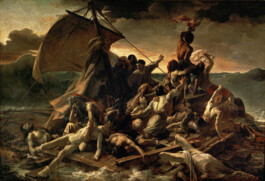
The raft of the medusa - salon 1819
by Theodore Gericault
Introduction
In the following paper will be presented and discussed the famous and controversial painting “The Raft of the Medusa” by Theodore Gericault presented at the Salon de Paris in 1819. The first part will address its historical context and the reception of the peers of the time, while in the second part the focus will be given to the Aesthetic Reception of Wolfgang Kemp methodology and the way the choice to send it at the London exhibition and the response of the British public influence its receptive elements. As conclusion, it will be sustained that the several iconographic and exhibition decisions made by the painter give to the artwork had an inclination towards a shocking and provoking relation with the beholder.

Caption here
Context
The Salon of 1819 - displayed in the Salon Carré and the long gallery of the Louvre - was a large and ambitious project commissioned by the, returned to power in 1815, Bourbon government with around 1.620 entries among paintings, sculptures and engravings (with 30% more than 1817) in the livret. As only those favoured by major commissions could actually afford to dedicate their time, energy and money for this grandiose event, some artists chose to ratify their support of the Bourbon dynasty representing personages or incidents recalling ancestral glories of the reigning family. As the opening date coincided with the feast day of Sant Louis, the patron of the monarch, the ceilings of the Grand Staircase leading to the Musée Royal and exhibition spaces were newly allegorically decorated by Abel de Pujol and Charles Maynier, representing the rebirth of the arts and celebrated royal patronage. In addition, a special exhibition illustrating the industrial progress was put in the newly decorated East Wing.[1]
Because of the special occasion, even the Bonapartist Baron Gros exhibited the large Embarkation of the Duchess of Anoulême, honoring the royal princes staunch but losing effort to maintain the Bourbon hold upon Bourdeux.[2] Additionally, sculptures by Dubaty and Bosio, representing nymphs and female nature spirits of the Greek and Roman tradition, were also at the Salon, as well as Parant’s Apotheosis of Henry IV painted on porcelain. Due to the new political circumstances, the Napoleonic supporter Jacques-Louis Davide had gone into exile in Brussels, marking a new post-Davidian era for the Salon, where unconventional artworks were presented that year, like the Ingres’ exotic Grande Odalisque, which was negatively commented due to its distorted anatomy. Although not actually exhibited in the Salon, David’s latest work, Cupid and Psyche from 1817, was indeed accessible in a private collection.
Caption here
The painting
He was only twenty-six at the time he painted the Medusa, Géricault had already known both success and disappointment at the Salon. His first exhibition entry, the Charging Chasseur, had won admiration in 1812, but the Wounded Cuirassier, shown two years later, did not sustain the promises of his auspicious debut. He left Paris of a lengthy sojourn in Italy, where certain tensions in his creative personality.
The figures represented, even if the painting was placed in the prestigious category of historical subject, are not national warriors or mythological heroes, but simple mundane shipwreck survivors.[3] The scene depicted, is the aftermath of the 1816 wreck of the French Royal Navy frigate Medusa, which ran aground off the coast of Senegal for a colonial expedition. Due to the incompetence and irresponsibility of the captain - a repatriated noble who had gained the position only because of his connections to the Bourbon Resotration government - the criminal lack of safety provisions and shortage of lifeboats made 150 survivors embark on a raft.[4] The captain fought to save himself and senior officers while leaving the lower ranks to die. There they were let to the fate, decimating by starvation during 13-day ordeal, waiting for aid and salvation.[5] Only a handful of 15 remained and were actually rescued by the Argus, of them only 10 reached land alive. According to the critic Jonathan Miles, the raft carried the survivors “to the frontiers of human experience. Crazed, parched and starved, they slaughtered mutineers, ate their dead companions and killed the weakest”.[6] Two of the survivors, Henri Savigny and Alexandre Corréard, published and account of the episode, which provided Géricault the perfect motivation to do research and work of the event. He dedicated his time interviewing the survivors and visiting the Beaujon hospital to study the dead and dying, compiling his “dossier”. The ship’s carpenter himself helped him in his preparation recreating a faithful model of the raft, and accounts say that Gericault’s studio was encumbered by bits and pieces of actual human remains, suggesting a kind of morbid fascination that probably exceeded the simple-essential demands of reportorial accuracy.[7]
Caption

Caption
Reception History and Critics
The crude and macabre realism, the treatment of the controversial subject chosen of the incident as an epic-historical tragedy, and the technical skills and drawing expressivity, gave the painting a great dignity carrying it beyond the mere reportage of a real event. This, however, provoked a dichotomy of reactions to the public and critics of the time. The unprecedented portrayal of the mundane real dead and dying of ordinary people in a dramatic and carefully constructed composition - usually worth the attention of important and significant historical heroic events - had the gaze and reaction of the public challenged. As the tragic event was a scandal that had considerable implications in France, the painting was greeted both with hostility - by the government and new regime enthusiasts - and with simpathy by those against it. Due to this controversial subject and ‘uncomfortable’ context, the Salon director of the time, the Comte de Forbin, altered the title in the catalogue to a generic and neutral Scene of a Shipwreck - although the public was well acquainted and familiar with the incident. It is said that even Louis XVIII himself encountered Gericault at the Salon and with simpathy and probable irony commented that “Monsieur, vous venez de faire un naufrage qui n'en est pas un pour vous” (“Sir, you've painted a shipwreck, but it's not one for you”)[8].
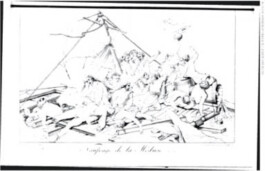
Critics, connoisseurs, and artists were concerned about the decline and degeneration of the Davidian tradition. Exemplary was the reaction and fear expressed by the famous critic Auguste Hilarion Kératry: David, where are now?[9], as well the title chosen by the sympathetic to the Davidian School writers L’ Heritier, de Latouche, and Deschamps for their critical review Lettres à David (Letters to David). In this review, where twenty engravings by Ambroise Tardieu were included, the painting is acclaimed for its creativity, design and movement.[10] The details of the figure waving the flag, the dead body in the lowest part and the figures of the father and son are pointed out for the attention given, however the colour scheme and the feeling of properly unfinished work are the major flaws. It seemed at the time that Gericault didn’t spent the necessary time to complete the work properly and didn’t critiques were made on the lack of transparent and elegant use of colours for the waves and pigments of quality.
In accordance with Kératry complaint, they comment the way painting is changing towards a more Romantic direction, as the Raft of the Medusa encompasses uncontrolled horrific emotional content, opposite to the Davidian noble simplicity and calm grandeur of the Neoclassical aesthetics.[11] The choice of the death and human suffering, not linked to a heroic and grandiose scene, went against the classical and ideal delicacy with which similar events were usually depicted. The subject and the iconographic execution by Gericault were a strong contrast of elements, as the dead of mundane bodies were not commonly developed within a dramatic and carefully constructed composition, and remarkable passion.
We can perceive the impact of this news and scandal on the flesh portrayed in almost macabre realism, but also dramatic heroic-epic way.[12] It is said commonly beautiful world on his virtuosity and interesting tonalities, which give great dignity and something more than a mere report of the event. But some critics of his time, and also of today’s times, actually disagree, as they believe the impact and sensation he created was more based on the subject and the “morbid fascination” on the whole preparation-execution.
Last to add, the painting was only purchased by the Louvre director, the same Comte de Forbin who had altered the title at the catalogue, after the painter’s death in 1824 after the painter’s death.
Conclusion
In order to bring the discourse to a conclusion, we can take into consideration the different aspects of the Raft of the Medusa mentioned until now. As we have seen, the painting is an impacting one, addressing but also rejecting the beholder, making him/her feel incompetent and obliged to participate as a witness to this large scale raw death scene. A proper Davidian painter, attached to the neoclassical aesthetics and elegant approach, would never dare to undervalue his painting in the ‘unnoble’ London Exhibition of the Egyptian Hall. It would be an offence to let the English public mock and visually consume, without any ‘professional’ filter and critic eye, a proper and respected piece of art, worth its position at the Salon de Paris. The case of the Medusa, let us see how the painting wasn’t made to please the classical familiar French eye, but to attract and attack, to challenge the protected mind of the visitor of 1819 in France. The Medusa is raw, big and real, too real to digest, and too alien to the beholder, who is not welcomed by the struggling figures. The beholder must only watch, impassible and rejected by the inner action of the figures; a mere witness.
Original article (pdf)