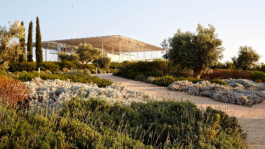
The Niarchos Effect
View of the canopy and part of the Stavros Niarchos Park.
Introduction
In the present paper it will be presented and analysed the visualization, realization and impact of the Stavros Niarchos Foundation Cultural Center (SNFCC) in Athens (Greece). Frist there will be a brief introduction on the project and its identity. Then the background and history of the vision of the Stavros Niarchos Foundation will be addressed, as well as the methodology and reasoning behind the actual realisation by the collaboration between the Renzo Piano Foundation and the Beta Plan Architecture Studio. Following, the main activities and initiatives of the SNFCC will be analyzed and commented based on the interviews and discussions with Spyros Yiotakis, Kalliopi Fysaraki, Aliki Karanikolas and Vicky Tsirou. Finally, a further analysis about the social and possible imact on the city and citizen’s life will made regarding their cultural and educational environment; the main achievements will be commented, but major importance will be given to the actual issues and possible problems this project has.
As the bibliography and actual publications regarding the cultural and social impact of the specific site are not sufficient, the present paper will take into consideration the official information provided by the SNFCC webiste, the Monograph published by the Renzo Piano Foundation, thesis dissertation of Greek students and personal observations through interviews and discussions with local people.
Brief Introduction
The Stavros Niarchos Cultural Centre is a complex constructed in Kallithea/Καλλιθέα in the south of Athens. The site includes the National Library of Greece and the Greek National Opera under and among a 170,000sq landscaped park. Both institutions are combined in one continuous building, with a public space called the Agora that is planned to provied common access to the two main facilities.
The Opera is composed by two auditoria and the Library is hosting 1,000,000 volumes, transferred between 2017 and 2018 from the previous building in the center. The library is intended not only as a place for learning and studying, but also as public and open, accessible to everyone. The glass-walled buildings are placed underneath the canopy roof, designed as an airplane, resistant to the strong winds that comes from the seaside. The SNFCC aims to create a visual and physical connection between the city and the water, the sea, with the canal that runs along the park in the Esplanade. The canopy roof helps also in providing the necessary shade for a place like this in a Mediterranean city like Athens, and is topped with 10.000sqm2 of photovoltaic cells, generating power for the Library and the Opera. Apart from this self-sufficient energy source, whenever is possible natural ventialation is used. The whole site is constructed in an artifical hill as going towards the south end of the area. The sloping culminates in the cultural center building, providing the views both of the sea, on one side, and the city, on the other.
Background - Past
In 1998 the first idea about creating the SNFCC was born, when the Stavros Niarchos Foundation decided to financiate construction projects that would host the new National Library of Greece, while hosting also parallel cultural and educational activities.
The project was then proposed to the Greek government, at the same time when the National Opera was requesting a proposal for its expansion and upgrade of its spaces. As both requests were accepted and backed by the SNF and the State, the idea of possibly placing both the National Opera and the National Library under one uniform space of educational and cultural character, within the context of a metropolitan and cultural area of international prominence. In 2006 the SNF announce the wish to construct, with its own funding the SNFCC (Stavros Niarchos Foundation Cultural Center). The ambitious plan would include the construction of the whole equipment of the two new buildings of the Opera and the Library. Next and around these two buildings, it would be created the 21,000 m2 Stavros Niarchos Park.
After several negotiations and meetings with the Ministry of Environment, Spatial Planning and Public Works, with the Municipality of Kallithea, it was decided that the multicultural and multidisciplinary space would be created in that area 4,5km South from the center, at the Delta of Phalerum/Φάληρο. The total extent of the territory is of 240.000m2, from which the 210.000m2 would be used by the SNFCC and the Espalanda (the Water Square), and the other 30.000m2 by the Kallithea Municipality for the creation of their Communal Sport Facilities Park.[1]
The vision of the Foundation was to promote the education and culture, that compose the spine of advanced society that wishes-wants to offer to its country and its city of Athenians “new organizational bases-foundations, foundamental elements in order to move-forward-advance, as well as a new context for the future. Education, culture, and sustainability, are three of the main elements of the SNFCC, they are foundamental prerequirements for the reinforcement of the dynamic perspective-optic of the city and of their people-citizens and their inclusion in the 21st century and a global context”[2].
On June of 2007, the necessary preliminary studies were published regarding the sustainability of the project and the Public Private Partnership[3] (“Μνημόνιο Συνεργασίας”) between the SNF and the Greek Public Sector was signed by the Prime Minister Konstantinos Karamanlis.[4]
Subsequently the Foundation published an international closed architectural competition and in February 2008, the Administrative Committe chose the Renzo Piano Building Workshop (rpbw.com). In March of 2009 the Foundation and the State signed the contract for the contruction of the SNFCC. In the contract is clarified that the complete economic expenses for the realisation of the project would be covered by the foundation and its further delivery, after its finalization, to the Greek Public Sector, which would have the complete control of its activity. This project is the biggest donation of the SNF ever made with a budget of 617€ million, while in the amount two more donations are included: one to the National Library and one to the National Opera, worth of 5 million euro each.
From a wider point of view, it has been the most significant cultural project of the last years and it is the first collaboration between the public and private sector. With the signed contract between the State and the Foundation, which was voted with the law 3785/200919, one whole organization (the SNFCC) was created under the form of an Anonymous Non-Profit Special-Purpose entity.[5]
The basic goal of the foundation was, first the study, creation and realization of the SNFCC and, after its completion the control, conservation, organization and active operation. During its construction the SNFCC was controlled by the SNF and the income of the Cultural Center came from the donations and the funding of the foundation. After the completion the Foundation gifted the SNFCC to the State and the Member of the Committee also were changed.[6]
Creation of Project - Past to Present
About the actual realisation, visualisation and reasoning of the idea behind, it appears interesting the lack of acutal studies and research done by the Renzo Piano Building Workshop, Betaplan or other entities involved in the project. When contacting the actual RPBW asking for sources and possible information regarding the who process and realisation of the SNFCC, I was impressed by the answer. The material received was mostly architectural, design, drawings and the Monograph, curated by Renzo Piano’s daughter, Lia Piano, which is filled with photographs, models and just a few - four or five - texts actually describing the logic behind. As researcher for such an impressive and important ‘monument’, which needed 10 years of work, I was expecting pages and pages of studies about the more social and environmental impact and relation with the surroundings and the city itself. But no such studies exist, neither much bibliography or reports of the last four years of its functioning, apart from some (again, few) interesting thesis dissertations of architecture, marketing and administration of touristic and cultural institutions.
The main source of the reasoning supporting the creation of the complex is the presentation of Renzo Piano himself, transcribed in the Monograph. By his description we see how the intention of the SFN was, as said previously, to gather into a single complex several functions: a large park, a theatre for music and opera, and a library. Important to denote that Athens had already and Opera house (the Olympia Theatre in the centre of the city, see picture), but it was no longer up to the required world’s circuits standards. The same was true for the previous State Library, which had become too small. The SNF did not hold and open competition, but selected some wellknown architects for a meeting with the board in Zurich in 2008. This first step already starts showing the probable actual intentions of the SNF, which was not to involve innovative young, and maybe local, professionals, but to call to collaborate already famous “names”.
Piano explains that the idea came from the low-lying nature of the city of Athens, and the need of a rising artificial hill in order to get a good view above the ground level. This was the initial and always consistent plan for the Kallithea district and, of course, by rising the level of the ground, Piano would be able to materialize the meaning of the neighborhood name “beautiful view” (κάλλος+θέα). The building would provide this for the visitors and the city, a beautiful panorama that was missing for a long time. As mentioned in the introduction, Piano recalls the idea of ‘reviving’ the disused and neglected buildings and area for the Olympics separated from the sea by a highway, creating a bridge, a link with the sea. Apart from this the scope was also to be able and highlight the most monumental elements of the city: the Acropolis behind the Kallithea quarter towards the center, as well as the rest of the hills (Lycabettus and Filopappou).
The main elements taken into consideration by Piano and Giorgio Bianci, the architect in charge, were, of course, the sea, the view, but also the intense sunlight and impreceptible slope of the hill that gradually ends up with the panorama view of the sea and the city. Thinking about the sustainability and environmental responability, the park and the roof of the site function as protection from the sun, and as a “flying carpet” as solar captor. The hill is placed 32.5 meters above the sea level and is accessible to anyone as the gradient is imperceptible thanks to the - not higher than - 5-6%.[7]
Next, Piano continues talking about the “beautiful” idea (I would like to remark the word “idea”) of physically and visually connecting the site to the sea by its canal. From the designs and models we can see that the initial intention was not only to create a kind of “pool” or artificial lake, but a proper canal that would end up in the sea. But in 2011-2012 and later in 2013 archeological excavations and research were made under the supervision of Eirini Skiadaresi and Dr. Stella Chrysoulaki found parts of an ancient road, which dates to the archaic period, specifically between the late 7th and the early 6th century BC, and one of the most significant necropolis in Attica of the Archaic period.[8] This caused a change in the plans and the canal was limited to The Pool. However, I find strange and irresponsible form the part of the teams and entities involved, the missing of this possible event, as finding ancient ruins underground is one of the most common issues of the city of Athens (and the whole country). Even the realisation of the undeground metro lines was famously challenged by this problem and numerous metro stations have chosen integrate the findings in the decoration. How couldn’t this been taken into consideration from the beginning of the project? And how did it “suddenly” appeared as a problem four-five years already into the construction of the site?
The third element was the “agora”, the urban space made for gatherin and sharing common values. The people would meet at this focal point, connecting the two main functioning spaces, the library and the auditorium. Deborah Nevins and Helli Pangalou were the landscapists and designed and worked on the study of the species, flowering patterns, colors and scents that would be integrated in the park covering the whole area. An adittional space was born on the roof the Lighthouse, as linking space to the library beneath, but also functional as reading room or other flexible and free use as meeting place. This idea of involving the citizens is clearly and many times mentioned by Piano in his presentation, as he explains that for this reason each June the complex was opened to the public and in this way since its beginnings it became progressively part of the city, adapting and merging with the landscape.[9] This effort of could be seen also in the competition addressed to architecture students for the creation of the Visitors Center of the SNFCC (won by Spyros Yiotakis and Agis Mourelatos in 2013).[10][11]
Present - Activities and Projects of the SNFCC
Today the SNFCC hosts several activities and initiatives of cultural, social, environmental and economic nature. Their official presentation says that the SNFCC is:“a public space, where everyone has free access and can participate in a multitude of cultural, educational, athletic, environmental and recreational activities and events. It includes the Greek National Opera, the National Library of Greece as well as the Stavros Niarchos Park.
The SNFCC was created thanks to an exclusive grant by the Stavros Niarchos Foundation, which delivered it to the Greek State upon completion. SNFCC S.A. is a public-benefit nonprofit organization responsible for the operation, maintenance and management of the Stavros Niarchos Foundcation Cultural Center and the Stavros Niarchos Park while developing and organizing its own series of cultural, educational, environmental and sports activities. It is supervised by the Greek Ministry of Finance.”[12]
Aprart from their cultural and environmental goals, the SNFCC and the Park aim to contribute to the revitalization of the Kallithea neighborhood and the Phaleron Delta waterfrom after years of neglect, as mentioned before by the vision and idea of the Renzo Piano workshop. They mention in their website that the free events and activities organized and hosted at the complex as well as the staff and their collaborations, have made (or at least wants to make) the SNFCC a reference point in the greater Athens area, redefining the concept of public space. They claim to be a public space “open to all, without barriers”.
In their list of activities they include the categories of culture (music, cinema, dance, theatre, exhibitions, sports, learning, school programs and for children, and nature), architectural landmark (the site as an point of interest of the international public), sustainability hub (projects, the deisgn, construction, operation and footprint of the complex itself are sustainable) and last they add the accessibility and social responsability. The main weight in the cultural sector has been given to the musical, theatrical and performative kinds of arts and to educational activities that involve the public in an interactive way. Although its rich program, we see a lower number of exhibitions, which seems understanable as there are several other institutions that have recently re-opened after some upgrades and renovations (National Museum of Modern Art on the Syggrou Avenue, the National Gallery of Athens, the Acropolis Museum, just to mention some of the biggest ones).

Future - Impact and vision
Said also by Renzo Piano in his presentation and written in their Monograph, the SNFCC has been considered as one of the major construction projects that has enriched the Greek economy and created employment as well as fluidity of capital in the middle of an arduous context. The SNFCC can host up to 32.000 visitors, from which the 4.000 can be hosted in the auditorium, the reception spaces and the buildings of the Library and the Opera.[13] From an official point of view and award winning, the whole projects seems to fullfil all the requirments and to get all the admiration. Proudly is clearly shown the Leadership in Energy and Environmental Design (LEED) certification which covers six key areas at both design and construction stages: Design & Construction Innovation, Energy & Air Quality, Interior Quality, Efficient Water Management, Efficient Use of Resources & Materials, Sustainable Landscaping.
The SNF has asked the Boston Consulting Group (BCG) to draft (2010) and update (2016) a study on the economic, environmental and social impact of the Stavros Niarchos Foundation Cultural Center (SNFCC).[14] The report conclusion finds that “the SNFCC [will] have a deep and lasting impact on a national and international scale. […] Is expected to become a cultural landmark for Greece, bringing with it numerous beneftis for Greece’s image, and in relation to other building projects of such scale and complexity, globally. […] The SNFCC construction has had a significant and positive impact on the Greek economy in a time of crisis, and will continue to do so during its operation. This positive impact includes the creation of jobds, spending in the economy and taxes generated;[…]” and that “is clear that the SNFCC has […] educational and cultural impact […] and has served as a construction “university”, up-skilling 6,000 unique laborers - as well as visiting architecture and engineering groups - with new construction and site management methods, some […] used for the first time globally”.
Last the BCG study adds into its consideration the expected increase of the number and types of visitors to Athens, and help in extending the tourist area of the city beyond the historical center, giving visibility also to the cultural landmarks located on Syggrou Avenue. This new international image is backed up by its sustainable design and construction. Last, interesting is that the section is called “Impact on Greece’s Image and Its People”, as it focused on the “image”, external, probably also superficial of Greece and its people. This can be seen also in the analysis and research made by Kalliopi Fysaraki about the representation and integration of the SNFCC space in the pictures of the users of Instagram. The BCG report actually talkes shortly about the
“numerous references to the SNFCC [that] have appeared in the international media, since [its] inception”.
Although the official presentation and studies included in the SNFCC and SFC websites are only positive and all their intentions are optimistic, there are some points that should be addressed regarding some mistakes or absent elements. One important concern is the possible consequences that this combination or intrusion of private entities in the public sector and its organizations (like the National Opera and the National Library). There is the fear regarding the “threatened autonomy of culture” before the pressure of the market and the generic economy. For this reason, natinal policies should look for the protection and preservation of the cultural identity and the reputation of the national cultural differences. In the times of globalization and the liberation of the market, the cultural has become one of the most dynamic and empowered sectors thanks to its rapid development that influences the international economy.
Culture and its activities represent one critically important productive sector, source of significant economic inflows, incomes and emplyment. Is also a prolific area useful for the exercise the governmental policies thanks to its ability to function as an intermediary between the local and regional development. One organization like this should have as as goal, not only the mediation and promotion of the artistic and cultural creatio, but also the dynamic participation of the individual. [15]

After discussing about the SNFCC idea and realisation with Spyros Yiotakis (winner of the Visitors Center competition in 2013), these were some of the conclusions. From a urban point of view, the area of Kalliteha increased in price and value. However, this was a profit only for the owners of the buildings already existing, as it didn’t actually improve the quality and life conditions of the residents and local smaller businesses of the district. One missing element we found problematic was the fact that the Municipality of Kallithea doesn’t allow the opening and creation of new leisure spaces (bars, coffee shops, smaller cultural-artisti spaces, etc.), so the presence of the SNFCC in the area concentrates all its activity within the confines of the complex, isolating itself from the bigger context. Although its full program and significant list of projects ongoing, the majority of them remain enclosed in its own perimeter, without actually touching and ‘expanding’ throughout the surroundings. Knowing this policy restrictions it seems that probably the SNFCC wasn’t an actual donation to the public sector, but more an investment concetrated in itself, challening its own concept of sustainability. It probably is environmentally sustainable, but its isolated nature and state leaves behind its social and cultural sustainable development. The main benificiaries of this new presence are the already wealthy owners of the offices buildings and hotels located along the Syggrou Avenue.
Local citizens visit and participate in this space, sharing experiences, moments and ‘visual memories’ (posted on the social media), but its monumental presence and scarse and problematic public transportation system (they had to provide the free service of shuttle buses every hour between the SNFCC and the Syntagma Square), makes these visits actual excursions that have to be pre-planned and well programmed.
Is important also that, in contrast with other cultural centers of private foundations, this hosts two extremely important public symbols: the National Opera and the National Library. The theatre, the music, the literature and history of the country. This private cultural center, although donated to the public sector, has its name above these two cultural institutions. The name Niarchos now, overshadows the National Opera and the National Library, putting the private sector in control of the public cultural heritage. Was this a mere donation or an actual investment and self-promoting project? These details make us think that the second option could be the more plausible. Even though officially the State and public sector is who administrate the SNFCC, the fact that is hosted and dependant of the structure and name of the SNF, makes the public heritage dependant of the protection and indirect control of the private entity.
Instead of just donating and empowering the already existing two public cultural institutions, the SNF seems to have ‘emptied’ the center from its symbolic cultural mediators and brought them under its domain, leaving behind the original buildings. These sites in the center of the city were important as their presence there activated the social and economic activity of the area as their visitors would consume in leisure, cultural and artistic capital.[16]
This “SNFCC-centered” perspective can be seen also from the aesthetic point of view of the whole complex. As commented by Spyros but also Aliki Karanikolas (Architect and Designer), the “good profile” of the places is faced only towards the point of view of the Syggrou Avenue, which has no sense because is not the common place for individuals and pedestrians to observe the whole site. From the actual Phalerum port (see picture) the view of the SNFCC is a simple cement block, as if it was forgotten that the complex should be seen also from there. It seems like the idea was only to make Athens and the sea beautiful and visible from the SNFCC, forgetting that it would be part and should be visible from the rest of the city itself. I agree with Aliki, as also from the West part of Kallithea, the only view of the site is a boring and poor, again cement block of the parking condo. It feels irresponsible towards these points of the city and the actual people living in the area to have left apart the idea of the SNFCC should be also “observed” and not be the only “observer” of Athens.
This distance and “cold” presence of the SNFCC in the city but also the social lifes of the visitors can be seen in how they project it in their picutres on Instagram. Kalliopy Fysaraki, in her thesis dissertation, finds three categories of how these users have included their environment into their picutres: the space as gaze towards the Athenian landscape, the space as a card-postal, and the space as institution. Kallia choose the Stavros Niarchos Park as “it is a contemporary example of Athenian public space, with many tourists and even more Athenians visiting the site on a regular basis.”.[17]
In the first category the Park of the SNFCC is brought into the pictures of the Instagram users asa beautiful simple view of a landscape. The represented landscape became a new mental categorization of the notion of a cultural space in Athens. The extensive intervention in the original landscape, which involved intense and significant academic and politic discussion for a long time, helped in this new meaning and perception of the new site. It provides an image of the space from a distance, the viewer pervieves its own city from afar and above, shrinking the size of the idea of the city. Athens became a possible background for the tourist or mere visitor, a view that now one can bring with them when leaving. The whole city and its image becomes a simple background to be photographed and constricted in the squared limits of the Instagram photo.
The same happens with the SNFCC itself and the Park. The fact that it has been overphotographed in all possible ways gives a more superficial, touristcally consumable idea of the landscape. It became a new Acropolis, a well-known location on Instgram, famous to be tagged and become a trend. This easy visual over-reproduction of the SNFCC image on the digital platforms has been encouraged also by SNF’s own public image and communication. It promotes itself as an essential and must to visit for the former and new tourist of Athens, it ‘sells’ itslef as a new Eiffel Tour or Pompidou (also designed by Renzo Piano) that has self-proclaimed to have “world scale importance”. Is this the actual scope of the site? To become the center of the selfies and Instagram location tags? From its lack of actual impact in the area and the rest of the city point of view, it seems like the actual perspective was and is self-centered and the weight has been given in the names of the Stavros Niarchos Foundation and the famous internationally Renzo Piano Building Workshop.[18]
Conclusion
In conclusion we can see that the nature of the SNFCC can be seen as a true revolution or as a ambitious project. We cannot overpass the actual and real positive impact that this complex has brought to the city and the specific area, as it has upgrade the value and aesthetic expectation. Surely the future generations, having and participating actively in this new green, sustainable, cultural and accessible environment will be influenced and inspired. The psychological and educational aspect cannot be doubted and the effort that is made in creating opportunities for the local people to learn, act, enjoy and participate is clear. However, some other issues that seem to be forgotten since the beginning of the realisation of the project leave a bitter taste in the bigger context. How could a such serious and important project forget about the existence of ancient remains in a country like Greece and its capital? How could not been taken into consideration the fact that its presence wouldn’t actually be able to affect the rest of the neighborhood due to its policy restrictions? Renzo Piano in his presentation seems sincere in his intentions, but the result shows a lack of awareness of the reality of the area and society in which this new edifice would be inserted. However, it remains a new, innovative, environmental sustainable and active organisation that is only four years old (with one and half challenged by a pandemic), so we remain patient and hopeful for a natural evolution and adaptation to the Athenian reality.
View of the canopy and part of the Stavros Niarchos Park.
Plan of the SNFCC and Stavros Niarchos Park complex
Theatre Olympia Previous National Library
View of one of the auditoria of the new View of the entrance of the new
National Opera National Library
View and map of the location of the SNFCC in the area of Kallithea and the Phalerum port

View of the SNFCC from the Phalerum port View of the ‘facade’ of the SNFCC from the side of The Pool facing Syggrou Av.
Instagram picutres taken of and in the site of the SNFCC and the Park, as decorative background and as important tagged location.

View of the Visitors Center designed by the competition winners Spyros Yiotakis and Agis Mourelatos
Bibliography
The main information about the SNFCC was found from the research of the documents of the SNF and the SNFCC, their websites http://www.snf.org, http://www.snfcc.org, the material provided by the RPBW, the thesis dissertations and from personal interviews and discussions withe local professionals and residents.
- Boston Consulting Group (BCG) Report, draft (2010) and updated (2016), on the economic, environmental and social impact of the Stavros Niarchos Foundation Cultural Center (SNFCC).
- Fysaraki Kalliopi, “Faces in the public space. Photographs with the Stavros Niarchos Park as background”, thesis dissertation, Athens 2019
- Monograph, Renzo Piano - Atene, Stavros Niarchos Foundation Cultural Center, Fondazione Renzo Piano, curated by Lia Piano, 2016.
- https://www.grekodom.com/news/2016-02-08/the-excavations-of-the-26-epca-at-the-falirondelta
- Marinos Georgios, “Stavros Niarchos Foundation Cultural Center and the Urban Reality”, Thesis Dissertation, April 2014.
- Mastichiadou Zoi, “New Cultural Policy of Athens. The contribution of the Foundtions: Stegi,
SNFCC and the Acropolis Museum”, thesis dissertation, Athens 2017. - Xrisoulaki Maria, “The Contribution of the Stavros Niarchos Foundation Cultural Center”, Pyrgos 2019.
- Sainati, Tristano; Brookes, Naomi; Locatelli, Giorgio (2016-09-19). "Special Purpose Entities in Megaprojects: empty boxes or real companies? Literature Review". Project Management Journal. 48 (2): 55–73.
Interviews of Architecture Students, Researchers, Architects, Art Historian: Spyros Yiotakis, Kalliopi Fysaraki, Aliki Karanikolas, Vicky Tsirou.
References
| [1] | Mastichiadou Zoi, “New Cultural Policy of Athens. The contribution of the Foundtions: Stegi, SNFCC and the Acropolis Museum”, thesis dissertation, Athens 2017. |
| [2] | From https://www.snfcc.org/en/snfcc/vision |
| [3] | Boston Consulting Group, “Stavros Niarchos Foundation Cultural Center (SNFCC). Updated Impact Study: Executive Summary”, study report, February 2016. |
| [4] | Kathimerini, (https://www.kathimerini.gr/politics/897736/i-fotografia-toy-k-karamanli-10-chroniaprin-kata-to-schediasmo-toy-kentroy-politismoy-stayros-niarchos/) |
| [5] | Sainati, Tristano; Brookes, Naomi; Locatelli, Giorgio (2016-09-19). "Special Purpose Entities in Megaprojects: empty boxes or real companies? Literature Review". Project Management Journal. 48 (2): 55–73. |
| [6] | Mastichiadou, p. 51-56 |
| [7] | From Renzo Piano presentaiton transcribed in “Atene, Stavros Niarchos Foundation Cultural Center”, curated by Lia Piano, Fondazione Renzo Piano, 2016. |
| [8] | From https://www.grekodom.com/news/2016-02-08/the-excavations-of-the-26-epca-at-thefaliron-delta |
| [9] | From Renzo Piano presentation in the monograph. |
| [10] | From https://www.snf.org/en/newsroom/news/2013/10/the-visitors-center-at-the-stavrosniarchos-foundation-cultural-center-has-opened-its-doors/ |
| [11] | From https://www.archdaily.com/557166/visitors-center-of-the-stavros-niarchos-foundationcultural-center-betaplan |
| [12] | From https://www.snfcc.org/en/snfcc/meet-the-snfcc. |
| [13] | Mastichiadou, ibid. |
| [14] | From https://www.snf.org/en/newsroom/news/2016/02/snfcc-impact-study/ |
| [15] | Mastichiadou, ibid. |
| [16] | From interview of Spyros Yiotakis, 6th of May 2021. |
| [17] | Fysaraki Kalliopi, “Faces in the public space. Photographs with the Stavros Niarchos Park as background”, thesis dissertation, Athens 2019. |
| [18] | Fysaraki, ibid. |